
EUVP visit story - Gahon Chiang
I joined the EUVP from September 7 to 11, 2026, just as Brussels was settling back into its usual rhythm after the summer holidays. On my first morning, one presentation slide caught my attention.
It showed a timeline of European history, with black lines representing war and white lines representing peace. For centuries, black dominated the image. Yet, as European integration began from 1950s, a remarkable stretch of white emerged.
That image stayed with me throughout my visit. It reminded me that peace is not simply the absence of war. It takes dialogue, institutions, and cooperation. But peace also depends on our ability to prepare for crises and protect the systems that sustain our societies.
As a senior legislative analyst working on foreign affairs and security policy in Taiwan's Legislative Yuan, I joined the EUVP to learn how Europe builds resilience through technology, institutional cooperation, and practical policies.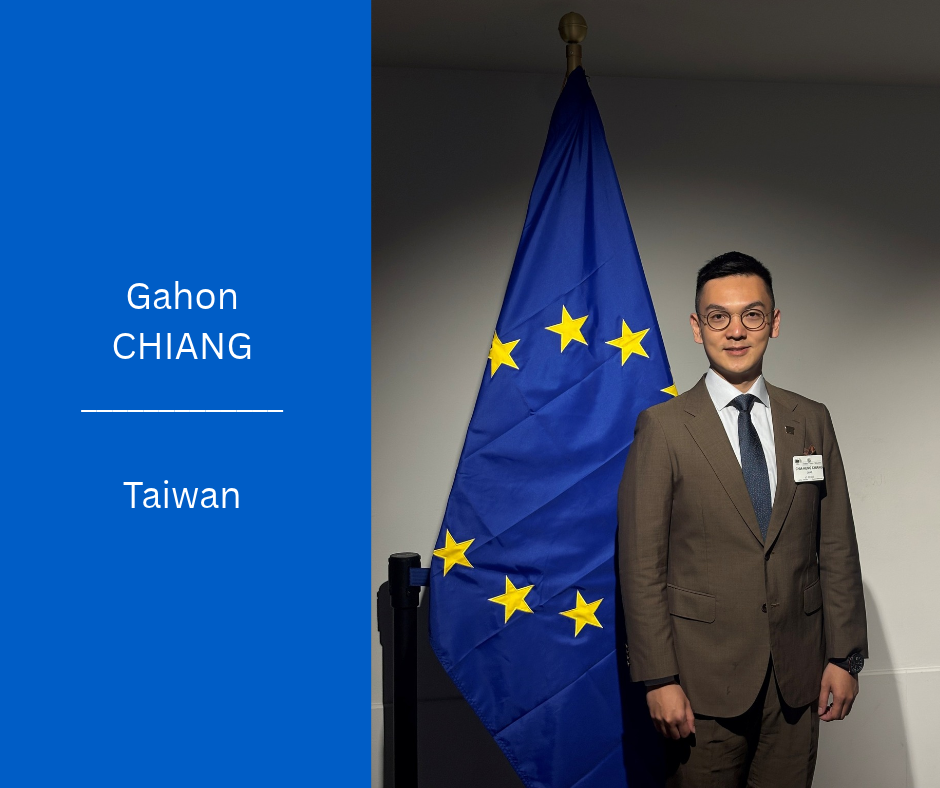
My main interest was satellite communications. I wanted to understand how the EU develops low-Earth-orbit satellite capabilities and uses them to strengthen communication resilience. Initiatives such as IRIS² offered valuable insights into secure connectivity and emergency preparedness.
I also explored maritime security and the protection of critical infrastructure. Through EU-CRIMARIO and its IORIS platform, I learned how maritime authorities share information and coordinate operations. These discussions showed me how information sharing can strengthen maritime awareness and support cooperation during crises.
At the European Defence Agency, I focused on another challenge: how to bring commercial innovation into arm procurement. Traditional procurement remains essential, but emerging technologies often develop faster in the commercial sector. I wanted to understand how governments can adopt these technologies more quickly and translate them into practical defence capabilities. Our discussions highlighted the importance of flexible procurement and closer cooperation between civilian industries and the defence sector.
Together, these exchanges shaped my understanding of resilience. Governments need more than advanced equipment. They need reliable communications, adaptable procurement systems, and institutions that can respond to new challenges.
Beyond the policy meetings, I enjoyed conversations with fellow EUVP participants from Ukraine, Palestine, Argentina, and other parts of the world. We came from different backgrounds and faced different challenges. Yet we shared a common interest in peace, security, and international cooperation. These conversations gave new meaning to the EU's motto, United in diversity.
They also encouraged me to reflect on Taiwan's place in the international community.
Taiwan has mature democratic institutions, a competitive market economy, and world-leading technology industries. Yet we face unusual restrictions on international participation.
For Taiwan, we cannot afford to pursue ideals without understanding power. Nor can we focus only on power while abandoning the rules that protect smaller democracies. Power matters, but rules matter precisely because power is unequal.
I believe Taiwan's international relevance should not be measured by formal diplomatic recognition alone. We can also build trust through transparent governance and practical contributions in semiconductors, artificial intelligence, public health, and disaster preparedness.
International space may be constrained by power, but international influence can still grow through competence and cooperation.
Looking back on my visit, I found myself thinking again about that historical barcode. Europe's experience reminded me that peace is never guaranteed. People must sustain it through dialogue, capable institutions, and a shared commitment to cooperation. These are also the foundations of resilience.
I am grateful to the EUVP team, the European officials who shared their expertise, and my fellow participants for their generosity and friendship. I return to Taiwan with new perspectives on European cooperation and fresh ideas for my work in the Legislative Yuan.
And one final confession: the pizza at the EEAS staff cafeteria was the best pizza I have ever had. I came to Brussels expecting lessons on European security and resilience. I certainly did not expect to discover my new favourite pizza!