
EUVP visit story - Abraham Kahasha
ABRAHAM KAHASHA KABRAL - BRIDGING BRUSSELS AND THE AFRICAN GREAT LAKES REGION: MY EUVP JOURNEY
Testimony of Abraham Kahasha Kabral, originally from Goma, Democratic Republic of Congo (DRC)
Walking into the European Parliament on my first morning in Brussels, I felt both the weight of history and the urgency of today’s challenges. The European Union Visitors Programme (EUVP) offered me a week of immersion in the institutions, values, and debates that shape Europe’s role in the world. For me, as a Peacebuilder from the African Great Lakes region, it was more than a study tour; it was a mirror reflecting how global values connect to local realities.
The week unfolded through guided tours, policy dialogues, and forums on democracy, climate, and migration. Each encounter revealed the EU’s commitment to solidarity, democracy, and human dignity. These principles resonated deeply with my own work across the region. As a Founder of The World and Peoples Transform/in Transformation (WOPT), I lead initiatives that foster dialogue across borders, empower youth, and transform conflicts in the Democratic Republic of Congo, Rwanda, Burundi, Uganda, and Tanzania.
One highlight was attending the EU Parliamentary Democracy Forum, where legislators and civil society from 27 member states explored how citizen engagement strengthens democracy. It reminded me of my project implemented in 2025 called The Voices of Peace and Justice (VoPJ): “Empower Refugees, IDPs, and Host communities through Peace Talks”, which amplifies 33 voices of marginalized people in fragile contexts in the Democratic Republic of the Congo (DRC) from the North and South Kivu Provinces. The EU’s emphasis on participatory governance affirmed that inclusive dialogue is not only possible but essential.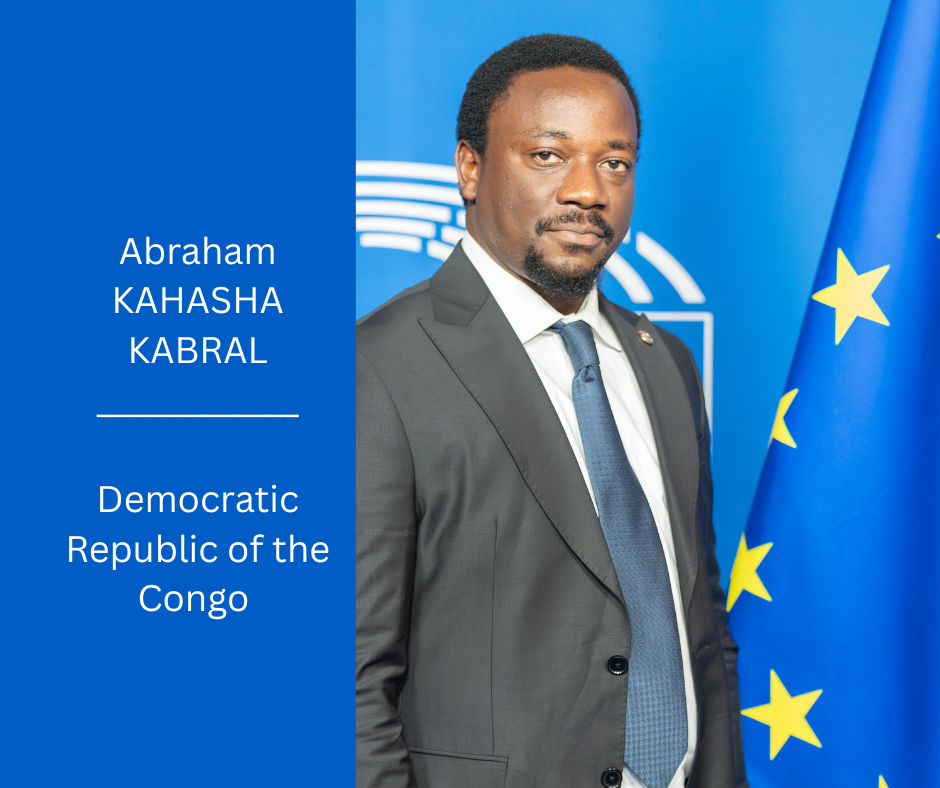
Climate diplomacy was another theme that struck me during my EUVP experience. Meetings at the European Commission underscored how environmental security is inseparable from peacebuilding and security in the current situation in the East of the Democratic Republic of the Congo (DRC), enhancing the capacity of the local people to integrate climate into foreign policy. The World and Peoples Transform/ in Transformation (WOPT) will integrate climate adaptation into grassroots peacebuilding just as the EU is doing in other countries.
Also, we discussed the Peace Booster Great Lakes: “Boost Our Peace, Spread Our Security” (PBGL) project, which is the first youth-driven digital platform in Africa designed to transform smartphones into tools for peace. By equipping young people across the Democratic Republic of Congo, Rwanda, Burundi, Uganda, and Tanzania with practical knowledge, the app empowers them to prevent violence, foster dialogue, build networks beyond borders and stereotypes, and reinforce resilience. Anchored in the EU’s values of solidarity, democracy, and human dignity, the PBGL project bridges grassroots innovation with global policy frameworks. The PBGL project is more than technology; it is a movement to boost trust, amplify youth voices, and create inclusive systems for lasting peace in the Great Lakes region shared by 5 countries. The EUVP inspired me to expand this initiative to young people from Kenya and South Sudan, equipping them with tools to prevent violence and build resilience, and making use of Artificial Intelligence (AI) to advance peace and security and the participation of women and young girls in the peace process.
During my EUVP week, I reflected on the multiple peace efforts shaping the Democratic Republic of Congo and Rwanda, including the Doha talks, Washington mediation, Paris initiatives, African Union mediation, and the Nairobi and Luanda Agreements. Each of these frameworks represents an important attempt to restore trust and stability in the Great Lakes region. For me, they are not just diplomatic milestones but living commitments that must reach the grassroots. That is why I launched the PBGL project.
Migration and forced displacement were also central to my reflections. The EU’s policies on asylum and borders are connected directly to my work within The Refugee Bank for Africa (RBAf), which I founded in 2021 as the first humanitarian bank in Africa offering interest-free, non-repayable loans to refugees and IDPs in displacement. By restoring dignity through financial inclusion for the most vulnerable, the Refugee Humanitarian Bank in Africa embodies the EU’s value of solidarity. Seeing how the EU addresses migration challenges gave me new ideas for scaling this model across regions.
Beyond the formal sessions, the week was a journey of perspective. Walking through the House of European History, I was reminded that Europe’s story is one of resilience through diversity. That same lesson applies to the EU - Great Lakes regional project led by Konrad-Adenauer-Stiftung (KAS) with 5 local partners from 5 countries in Africa, for which I worked as a Regional Project Assistant and later as a Regional Project Security Officer in the Great Lakes region called the Great Lakes Youth Network for Dialogue and Peace: Our diversity - Our opportunity co-funded by the European Union (EU).
The EUVP experience was not just about learning; it was about connecting with other young leaders from Europe and Africa. It showed me how European values can inspire African innovation, and how grassroots initiatives can enrich global frameworks. I return to my work with renewed conviction. Peace, climate resilience, and refugee empowerment are not separate struggles, but interconnected pathways to justice.
As I continue leading The World and Peoples Transform/ in Transformation (WOPT) and The Refugee Bank for Africa (RBAf), I carry with me the lessons from Brussels. The EUVP week was a catalyst, reminding me that building inclusive systems is a shared responsibility. Europe and Africa may be continents apart, but our futures are intertwined.