
EUVP visit story - Swati Prabhu
Strengthening Ties between the EU and India in a World of Uncertainty
India
As an early-career researcher from India, my visit to Brussels as part of the European Union Visitors Programme (EUVP) was truly an enriching experience. As a key tool of public diplomacy advancing people-to-people contact, the EUVP is an excellent initiative to broaden one’s understanding about the EU and its associated functioning mechanisms, especially in terms of institutional drivers, decision-making bodies and the responsibility matrix.
Though I have been engaging with the EU as part of my coursework during my doctoral studies at the Centre for European Studies (CES), Jawaharlal Nehru University (JNU), the visit opened a gamut of new ideas, perspectives and notions. Given my current research at the Observer Research Foundation (ORF) pertains to development cooperation, EU-India relations, EU development policy, and sustainable development, the EUVP offered a perfect platform to gain tangible insights on some of these issues.
My visit to Brussels in May 2026 also came at a time when political and economic shocks were at their peak. Given the US-Iran conflict impacting every inch of the global economy and the development landscape, the main objective of my visit was not only to understand the EU’s institutional architecture, but also what roadmap Brussels would adopt, in terms of partnerships, connectivity and sustainable development. 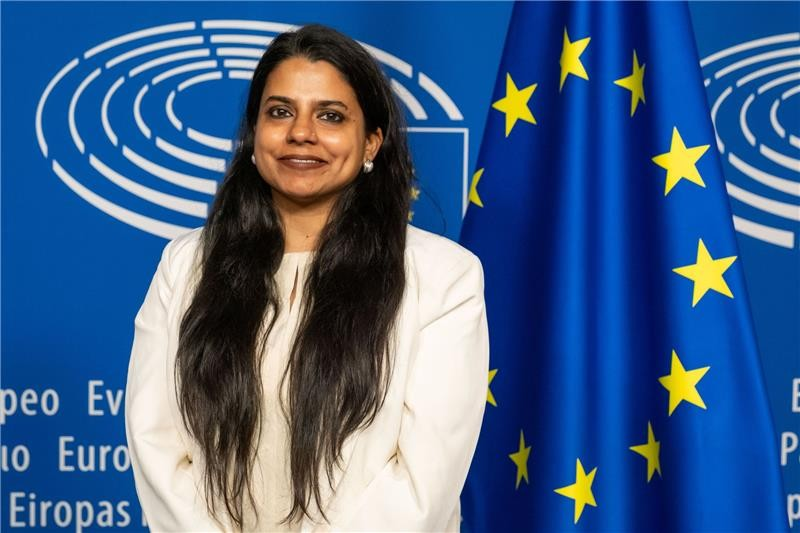
It is a well-known fact that the European project is facing serious risks, yet it was quite encouraging to witness the positive outlook in Brussels towards sustaining and advancing this project. One of the key ways of furthering this is through diversifying and establishing relations with the global South countries, especially India.
Personally, the visit came at a very opportune moment for me. After publishing a book titled the “European Union’s Connectivity Agenda: Forging Partnerships for Environmental Governance” in November 2025, the global order drastically changed in 2026. With the Trump 2.0 introducing fresh economic and political jolts in early 2026, the EU’s connectivity agenda and its development partnerships have changed drastically.
During the visit, I had the opportunity to pose my queries and get a nuanced perspective on how the EU views connectivity, global environmental governance and sustainable development, as well as its strategy for building relations with the global South, including India. I engaged with several key officials of the Directorates-General of the European Commission for International Partnerships (DG INTPA), Climate Action (DG CLIMA), Education, Youth, Sport and Culture (DG EAC), Research & Innovation (DG RTD), as well as the Directorate-General for External Policies of the Union (DG EXPO) and the European Parliamentary Research Service (EPRS) of the European Parliament, and the European External Action Service (EEAS).
The conversations were deeply informative, in-depth and the interlocutors kindly agreed to have a frank discussion, sometimes even going beyond the allotted time. Their personal anecdotes, practical examples and on-the-ground insights helped deepen my understanding of the EU’s structures, institutions and processes. I realized that what we read in India about the EU is sometimes quite different from what happens in reality. Conversations on the EU-India partnership, critical minerals, emerging technologies, climate action, the contentious CBAM and reforming multilateralism, among other topics, proved to be very valuable.
Interacting with colleagues from South Korea, Azerbaijan, Kenya, and the African Union (AU) also added a valuable dimension to my experience. I would like to express my deep appreciation to Mr. Laurent le Danois and Ms. Aarti Kapoor at the Delegation of the European Union to India for nominating me and to Mr Andreas Kettis, Head of the EUVP Unit for conducting a brilliant programme. In fact, the EUVP Unit, a great bunch of energetic individuals, highly motivated and supportive, were always available to help in every way possible.
I am also deeply grateful to Ms.Ianthe van Gool, my Programme Coordinator, for thoughtfully curating such a remarkable series of meetings, squeezed within a week’s schedule. A special acknowledgment also goes to Mr. Robert Elsen for generously offering to read and review my book and to Ms. Christina Katsara for patiently answering my logistical queries and seamlessly organizing the trip. The EUVP experience indeed made my first trip to Brussels truly memorable, and I look forward to contributing to strengthening the ties between the EU and India in a world of uncertainty.